9 Best Travel Umbrellas Under $25 in 2026: Windproof, UV-Ready
As an Amazon Associate I earn from qualifying purchases. When you click a product link on truestylewdm.com and buy something on Amazon, Amazon pays us a small commission; the price you pay is the same. Read our affiliate disclosure.
Your bag size, your city's wind, and your sun exposure are the three numbers that sort every travel umbrella on this list.
Before you scroll to a pick, weigh these four factors in order. They drove every ranking decision on this page.
Folded length. An umbrella at 11–12 inches fits a standard tote or backpack side pocket. At 5.9–7 inches it slips into a crossbody or even a large jacket pocket. Longer folded length usually means a wider canopy, so there is a real trade-off.
Canopy diameter. A 40–42-inch arc covers one person comfortably. Anything smaller is shoulder-and-head coverage only. Anything larger adds weight and bulk that defeats the purpose of a travel pick.
Rib count and frame material. Eight or nine fiberglass ribs handle real gusts without inverting. Six ribs work for light wind and everyday showers. Steel shafts are heavier; fiberglass is lighter and flex-resistant.
These four criteria — folded length, canopy diameter, rib count, and UV rating — appear as fields on every product block below. The same checklist, applied in the same order across all nine picks reviewed here for truestylewdm.com.
Quick picks
- Check price
- Check price
- Best Build and AccessoriesLILAC compact travel umbrellaJapanese-grade pongee with accessories includedCheck price


- Best Value Auto Open/Close SIEPASA compact travel umbrella
- Best Classic Compact Rain-Mate compact folding umbrella
- Best Sun Protection BAODINI mini travel umbrella
- Best Ultra-Mini Moorrlii mini UV umbrella
- Best Pocket Pick with Hard Case Repel Mini travel umbrella
- Best Lightweight Everyday Jorilis compact travel umbrella
Know this before you buy Travel Umbrella Under $25
Check the folded length against your bag
Measure your bag’s widest interior pocket before ordering. Most compact travel umbrellas fold to 11–12 inches; true mini picks (Moorrlii, BAODINI) fold to 5.9–6.9 inches. A mismatch means the umbrella rides outside the bag, defeating portability.
Match canopy size to coverage needs
A 40–42-inch arc is the minimum for a single adult in moderate rain. If you share with a companion or carry a wide-brimmed hat underneath, size up. SIEPASA reaches 42 inches; the Repel Umbrella (B0160HYB8S) does not publish a canopy diameter in its listing.
Count the ribs before trusting a wind claim
Nine fiberglass ribs (Repel, TUMELLA) resist sustained gusts better than six (BAODINI). More ribs add slight weight but meaningfully reduce inversion risk.
Decide whether UV matters as much as rain
UPF 50+ canopies (Moorrlii, BAODINI, Jorilis) block up to 98–99% of UV, making them legitimate sun tools. Standard waterproof canopies offer no published UV rating. Choose a dual-purpose pick if you shop for sunnier climates.
Inspect the opening mechanism
Auto open/close (one-button) is faster one-handed. Manual open umbrellas (BAODINI) are lighter and simpler but require two hands in a downpour.
Check included accessories
A slip cover prevents drips inside your bag. LILAC adds a waterproof sleeve and carabiner; Repel Mini includes an EVA hard case; most others include only a fabric slip cover.
What the materials actually mean
Fiberglass ribs
Flex rather than snap in wind. Used by SIEPASA (8 ribs), TUMELLA (9 ribs), Repel (9 ribs), Rain-Mate, LILAC, Repel Mini, and BAODINI (6 ribs). The flex action is what prevents inversion; the rib count determines how much pressure the frame can redistribute.
Aluminum vs. steel vs. alloy shaft
Aluminum (Jorilis, Moorrlii frame) is lightest. Steel (Repel B0160HYB8S, Repel Mini) is heavier but very rigid. Alloy steel with black coating (LILAC) sits between the two and resists rust. For a narrower pick, see our best travel umbrella guide.
Pongee canopy fabric
LILAC uses pongee, a tightly woven polyester that feels silkier than standard nylon, dries quickly, and resists pilling. Most other picks use standard polyester, which is functional but slightly slower to shed water.
Teflon / DWR waterproof coating
SIEPASA specifies Teflon-based DWR, which beads water on contact. All picks here use some form of water-repellent coating; Teflon-treated surfaces tend to maintain repellency through more wash cycles.
Dual-layer UV canopy
BAODINI’s black-glue underside absorbs and reflects UV, claiming 99% blockage. Moorrlii and Jorilis list UPF 50+ without detailing the layer construction. Single-layer polyester canopies offer no published UV rating.
Handle materials: rubber vs. ABS vs. EVA
Rubber handles (TUMELLA, Rain-Mate, Repel B0160HYB8S, Jorilis) grip better in wet hands. ABS plastic (Moorrlii, Repel Mini, LILAC with PU coating) is lighter and more resistant to cracking in cold temperatures; BAODINI uses a PU spray matte handle rather than ABS. For a narrower pick, see our best for travel compression socks guide.
Capsule / EVA hard case
Moorrlii and BAODINI include a rigid capsule case that protects the canopy and prevents drip transfer to bag contents. EVA (Repel Mini) is semi-rigid. Fabric slip covers (most others) are lighter but offer no crush protection.
Our picks for Travel Umbrella Under $25
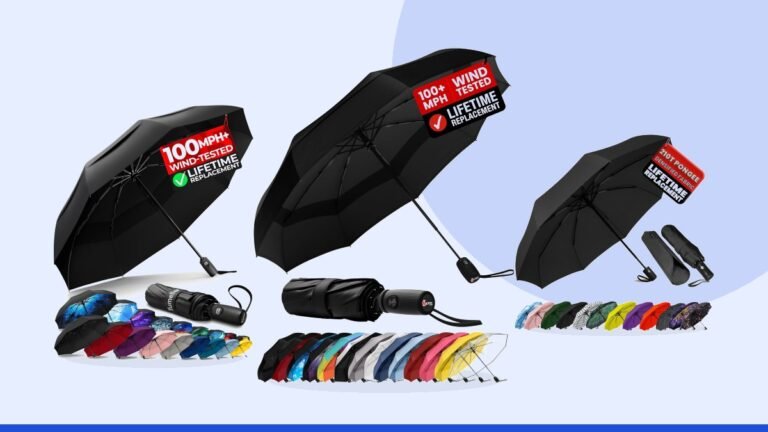
Repel Umbrella windproof travel — the double-vented standard

Verdict: Nine fiberglass ribs, a double-vented canopy rated to 100 MPH, and an 11.5-inch folded length make this the most defensible all-around pick for a commuter or traveler who faces real gusts.
The double-vented canopy is the structural feature that separates this Repel from most picks in this price band. Two canopy layers allow wind to escape upward rather than catch and invert the umbrella — a meaningful engineering difference from single-layer designs. Nine fiberglass ribs distribute lateral force across more flex points, and the steel shaft adds rigidity without the frame weight of an oversized golf umbrella. The latex-free rubber handle gives a secure wet-hand grip, which matters most exactly when rain arrives unexpectedly.
At 15 oz it is not the lightest pick here — the BAODINI weighs 8.6 oz and the Moorrlii is lighter still. The steel shaft contributes to that weight, and in a small crossbody every ounce registers. The 11.5-inch folded length fits backpacks and totes reliably but will not slip into a jacket pocket. Buyers who need a true pocket umbrella should look at the BAODINI or Moorrlii instead. The included cover and instruction manual are minimal extras; the LILAC at this price tier bundles a carabiner and waterproof sleeve for more carry flexibility.
What owners report
The listing has accumulated wide buyer attention and the wind-resistance claim is the feature most referenced in positive responses; buyers in coastal and urban environments specifically note the double-vented design held through sustained gusts. A smaller share of reports mentions the weight relative to ultra-mini picks as a mild complaint, particularly from buyers who carry small bags.
Who it’s for: Who it's for: Commuters and travelers who face genuine wind and need a double-vented, nine-rib canopy in a backpack-ready 11.5-inch packageSkip it if: Your bag is a mini crossbody or you primarily need sun protection rather than wind resistance. Use case: Urban commuter bag with gusty city weather
TUMELLA windproof travel umbrella — nine ultra-flex ribs, 100 MPH tested

Verdict: Nine ultra-flex fiberglass ribs and a claimed 100 MPH wind test give TUMELLA the strongest wind credential in this lineup, in a compact form built for one-handed use.
TUMELLA’s key differentiator is the rib specification: nine fiberglass ribs built with what the brand calls ultra-flex tech 2026, designed to bow under pressure rather than snap or invert. Combined with a drip-proof coating and a rubber handle for wet-hand grip, the umbrella targets the specific frustration of budget umbrellas that fail in the first meaningful storm. The aluminum shaft keeps the frame lighter than steel alternatives while maintaining the rigidity needed to anchor nine ribs under load.
Because the full listing detail is limited — canopy diameter, folded length, and weight are not published — it is harder to compare directly on the portability criteria that place Repel at the top. Buyers who need an exact folded measurement before ordering should note that gap. The rubber handle, while grippy, is a denser material than ABS and adds marginal weight. The included quick-start guide is a nice touch but adds nothing structural. For pure wind confidence at this price band, TUMELLA is the most explicit claim in the lineup; for a buyer who also needs confirmed sun protection, the BAODINI or Moorrlii answer the question TUMELLA does not.
What owners report
Buyer patterns on TUMELLA center on the wind-resistance promise; the 100 MPH claim draws attention from commuters in exposed locations. A minority of reports questions the absence of published compact dimensions, particularly from buyers trying to verify bag fit before purchase.
Who it’s for: Wind-first buyers who want maximum rib count at a budget price and can verify fit in person Skip it if: You need published compact-length specs to confirm bag fit before buying. Use case: Gusty-city commuter who prioritises inversion resistance above all else
LILAC compact travel umbrella — Japanese-grade pongee with accessories included

Verdict: A pongee canopy, alloy-steel-and-fiberglass frame, waterproof storage sleeve, and an included carabiner give LILAC the most complete carry package in this price band.
LILAC’s canopy material stands apart from every other pick here. Pongee is a denser, tighter-woven polyester that sheds water faster on the surface and resists pilling through repeated open/close cycles better than standard umbrella polyester. The alloy-steel shaft with black coating resists surface rust, and the frame combines alloy steel with fiberglass ribs — a construction the brand ties to 20 years of manufacturing for Japanese retail. The waterproof sleeve keeps bag contents dry when you stow a wet umbrella, and the carabiner clip lets you attach it outside the bag entirely. For a buyer who cares about the full carry system, not just the umbrella in isolation, those extras shift the value equation meaningfully.
The listing does not state canopy diameter, folded length, or weight, which makes direct spec comparison difficult. Buyers who want to verify coverage or confirm pocket fit before ordering are working with less data than the Repel or SIEPASA listings provide. The ABS+PU handle is styled for a clean urban look but offers less tactile grip than a rubber handle in heavy rain. For buyers whose priority is confirmed specs and maximum wind resistance, the Repel Umbrella (B0160HYB8S) or TUMELLA answer those questions more precisely.
What owners report
Buyers drawn to LILAC tend to highlight the aesthetic finish and the bonus accessories; the carabiner and waterproof sleeve are cited as genuinely useful rather than ornamental. A smaller group flags the limited published specs as a barrier to confident ordering.
Who it’s for: Style-conscious commuters who want a complete carry system — sleeve, clip, quality fabric — in a single budget purchase Skip it if: You need published dimensions and weight to verify bag fit — the listing does not provide them. Use case: Office-to-errand bag where the full carry kit matters
SIEPASA compact travel umbrella — Teflon DWR and 42-inch coverage at a low price

Verdict: Teflon-treated waterproofing, an 8-rib fiberglass frame, and a 42-inch canopy with one-button auto open/close make SIEPASA the most fully specified pick at the lowest end of this price band.
The Teflon DWR coating is the detail that elevates SIEPASA above generic budget picks. Teflon-based treatments bead water on initial contact more aggressively than standard polyester coatings and maintain that repellency across more use cycles before degrading. The 42-inch canopy is at the larger end of compact-umbrella coverage, and the 8-rib fiberglass frame keeps inversion risk low without matching the 9-rib construction of Repel or TUMELLA. At 11.8 inches folded it fits backpacks and standard totes; the included wrist strap is a small but practical carry detail.
At 14 oz (210 g) it is heavier than the BAODINI (8.6 oz) and significantly heavier than ultra-mini picks. The EVA handle — a softer foam-like material — absorbs grip pressure but offers less wet-weather control than a rubber handle in a downpour. The free-replacement guarantee covers manufacturing failures but does not change the fact that 8 ribs is the minimum meaningful wind resistance; buyers in regularly windy locations should weight TUMELLA or Repel higher. No UV protection is listed, so this is a rain-first pick.
What owners report
Buyers highlight the Teflon waterproofing and the auto open/close as the two features that justify the purchase; the wrist strap is mentioned as a convenience detail. A share of reports notes the weight relative to other compact picks, particularly from buyers who carry small bags.
Who it’s for: Backpack and tote carriers who want one-button convenience and Teflon waterproofing in a proven compact size Skip it if: You need UV protection or weigh ounces carefully in a small bag. Use case: Daily backpack or work tote in a rainy climate
Rain-Mate compact folding umbrella — reinforced fiberglass, clean and simple

Verdict: A reinforced fiberglass rib frame, rubber handle, and auto open/close in a metal-shaft design from an established brand — a no-frills pick for buyers who want reliability without extras.
Rain-Mate is the stripped-back option in a lineup of increasingly spec-detailed picks. The rubber handle gives reliable wet-hand grip; the fiberglass ribs flex rather than snap; the auto open/close works one-handed. Metal shaft construction is not as lightweight as aluminum alternatives but provides predictable rigidity. For a buyer who has carried budget umbrellas that failed and wants a step toward proven construction without spending more, Rain-Mate’s manufacturer (Upper Echelon Products) also makes the Repel line — the construction pedigree is shared.
The listing does not publish canopy diameter, folded length, weight, or rib count, which makes this the second pick in the lineup with a spec gap. That matters if bag fit is a deciding factor. No UV protection is listed. The description field is empty, leaving buyers to work from the category listing and brand recognition alone. Buyers who need confirmed dimensions should note the SIEPASA or Repel listings are more transparent. Rain-Mate’s inclusion in the stick-umbrella category rather than folding may indicate a slightly longer collapsed profile than the other folding picks — worth confirming at time of purchase.
What owners report
Buyers of Rain-Mate typically reference the shared manufacturing heritage with Repel and the rubber-handle grip as confidence signals. A minority notes the absence of published specs as a friction point before purchase.
Who it’s for: Brand-conscious buyers who want a fiberglass-rib, rubber-handle umbrella from a known manufacturer without extra features Skip it if: Published specs are essential to your buying decision — the listing does not provide them. Use case: Classic commuter carry when brand lineage matters more than spec detail
BAODINI mini travel umbrella — dual-layer UV canopy in a palm-sized fold

Verdict: A dual-layer black-glue canopy blocking 99% of UV, a featherweight 8.6 oz body, and a 6.9-inch folded length make BAODINI the strongest sun-and-compact combination at this price.
At 8.6 oz and 6.9 inches folded (8.At 8.6 oz and 6.9 inches folded (8.2 inches with the capsule case), BAODINI is the second-shortest pick in this lineup; most other picks do not publish a weight, so a lightest-overall comparison cannot be confirmed. The dual-layer construction — a black-glue underside that absorbs and reflects UV — is the most detailed UV claim in this lineup, with the brand citing 99% UV blockage and UPF 50+. That makes it a genuine sun-protection tool, not just a rain umbrella with a secondary UV claim. The 41-inch arc canopy is full single-person coverage; the capsule case protects the canopy from crushing in a bag and prevents drip transfer to other contents.
Six fiberglass ribs are the trade-off. The brand states directly that this umbrella is not designed for heavy wind, which is an honest specification but a meaningful limitation in coastal or canyon-effect urban environments. The manual open/close (no auto button) requires two hands in a sudden downpour. The lifetime replacement guarantee covers manufacturing failures, but replacing a wind-damaged umbrella with six ribs under a storm puts that guarantee to work quickly. For a buyer whose primary use is sun protection with incidental rain cover, BAODINI is the right answer; for a buyer whose primary use is rain in a windy city, the Repel or TUMELLA are more appropriate tools.
What owners report
Buyers praise the compact size and the UV claim as the two headline features; the capsule case is noted as a practical bonus for bag organization. A portion of reports reflects the brand’s own caveat about heavy wind — buyers in gusty climates report the six-rib frame flexes noticeably in strong gusts.
Who it’s for: Sun-first shoppers who want UPF 50+ coverage in a palm-sized, bag-friendly package for travel and daily errands Skip it if: You live in a windy city or need one-button auto open — the manual six-rib design is not built for sustained gusts. Use case: Crossbody bag for sunny-climate travel or theme park days
Moorrlii mini UV umbrella — 5.9 inches folded, capsule case, true pocket size

Verdict: At 5.9 inches (15 cm) folded, Moorrlii is the shortest pick in this lineup, with UPF 50+ sun protection and a rigid capsule case — a genuine pocket-carry option for small bags.
Five point nine inches is as close to a keychain as a functional umbrella gets at this price. Moorrlii achieves that size by reducing storage volume by 45% (the brand’s stated figure) relative to a standard compact, and the capsule-style hard case protects the canopy and contains post-rain drip. The UPF 50+ rated canopy with a layered water-repellent surface covers sun and light rain equally. The fiberglass shaft is lighter than the steel alternatives and contributes to the sub-7-inch fold.
The aluminum frame (not full fiberglass ribs) and ABS handle are the construction trade-offs. Neither the rib count nor canopy diameter is published in the listing, making direct wind-resistance comparison against TUMELLA or Repel impossible. The care instruction — wipe with dry cloth only — signals a canopy coating that is more sensitive to abrasion than standard polyester. At 5.9 inches this is not an umbrella for sharing or for sustained downpours; it is an emergency and sun-protection carry designed around the smallest possible footprint. Buyers who want auto open/close should note the listing does not confirm that mechanism; the Jorilis or SIEPASA are clearer on that feature.
What owners report
The defining buyer response to Moorrlii is the size; fitting a functional umbrella into a crossbody or jacket pocket is the consistently cited reason for purchase. A smaller share notes that the compact canopy limits coverage compared to 42-inch picks.
Who it’s for: Minimalist bag carriers who need a genuine pocket-size UV umbrella and accept limited coverage and no published wind rating Skip it if: You need confirmed coverage diameter or wind resistance specs — neither is published in this listing. Use case: Mini crossbody or jacket pocket for sunny-day errands with light-rain backup
Repel Mini travel umbrella — EVA hard case, steel/fiberglass build, pocket-ready

Verdict: An EVA semi-rigid case, steel shaft, and fiberglass frame bring Repel's construction pedigree down to a pocket-friendly footprint — a solid mid-ground between the full Repel and ultra-mini picks.
The EVA case is the feature that differentiates Repel Mini from the standard fabric-sleeve compact umbrellas in this lineup. Semi-rigid EVA protects the canopy from crushing under book weight in a bag and limits drip transfer better than a soft sleeve. The steel shaft and fiberglass frame match the construction logic of the full Repel (B0160HYB8S) in a smaller package; the ABS handle is a departure from rubber but lighter. The care guide explicitly states: close when not in use, dry completely before storing, and avoid folding while damp — practical advice that reflects how the frame and coating are designed to perform long-term.
Folded length, canopy diameter, weight, and rib count are not published in the listing, which is the same spec gap as the Rain-Mate and limits direct comparison. No UV protection is listed. The ABS handle provides less tactile grip than rubber in wet conditions; for a buyer in a reliably rainy environment, the full Repel’s rubber handle is a meaningful upgrade. At its price band, Repel Mini makes the most sense for a buyer who already trusts the Repel brand and wants the smallest carry format that brand makes, without the ultra-minimal coverage risk of the Moorrlii.
What owners report
Buyers cite the Repel brand name and the EVA case as the two purchase triggers; the semi-rigid protection for bag carry is specifically appreciated by buyers who have experienced damaged canopies from soft-sleeve umbrellas. Missing spec detail is noted by comparison-shopping buyers.
Who it’s for: Repel-brand loyalists who want the smallest Repel format with a protective case rather than a fabric sleeve Skip it if: You need UV protection or confirmed published dimensions — the listing does not cover either. Use case: Compact tote or small backpack where a hard case prevents canopy crush
Jorilis compact travel umbrella — auto open/close, UV blocking, rubber grip
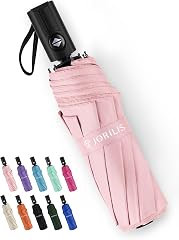
Verdict: Auto open/close, UV blocking, a non-slip rubber handle, and an aluminum frame make Jorilis a capable everyday carry — though limited listing detail keeps it at the base of this ranking.
Jorilis lists the core feature set a daily-carry umbrella needs: auto open and auto close for one-handed use, UV blocking canopy, waterproof and windproof designation, and a non-slip rubber handle that grips in wet hands. The aluminum frame (noted in specs) is lighter than steel shaft alternatives. The rubber handle is a genuine wet-weather advantage over ABS picks at the same price tier. The UV blocking claim, while not tied to a published UPF number, signals a treated canopy rather than bare polyester — meaningful for buyers who use an umbrella on sunny days as well as rainy ones.
The listing is the thinnest in this set: no canopy diameter, no folded length, no weight, no rib count, no description text. That absence is a material gap when this roundup is built around four measurable criteria. Every ranking comparison to Jorilis is an inference from the category and frame specs rather than a published figure. Buyers who need any of those dimensions confirmed before purchase will not find them here. The pick lands last not because the umbrella is poor — the frame and feature set suggest a competent everyday carry — but because less verified information means less confidence for a buyer making a decision remotely.
What owners report
Buyer patterns on Jorilis are limited by the newness of the listing; the auto open/close and rubber handle are the most referenced feature positives. The absence of published dimensions is flagged by comparison-driven buyers.
Who it’s for: Casual daily-carry buyers who want auto open/close and UV blocking and are not comparing specs across multiple picks Skip it if: Published specs matter to your decision — this listing provides almost none. Use case: Low-research everyday carry when brand-loyalty to a name is not required
Compare the Travel Umbrella Under $25 picks
The table below maps each umbrella to three buyer profiles: the commuter who needs pure rain defense, the traveler who wants dual sun-and-rain coverage, and the minimalist who prioritizes bag space above all else. Suitability in each cell comes from published specs and listing claims rather than lab results.
Use the Notes column to catch key trade-offs at a glance — rib count for wind resistance, folded length for bag fit, and UV rating for sun markets. No single pick scores top marks on all three profiles, which is exactly why the full ranking matters.


Decide on Travel Umbrella Under $25 the right way
Dry it completely before storing
Every manufacturer in this lineup — Repel Mini’s care guide states it explicitly — recommends closing the umbrella and drying it fully before sliding it into its sleeve or case. Storing damp accelerates corrosion on steel and alloy shafts and breeds mildew on polyester and pongee canopies.
Store open, not compressed, when possible
Long-term compression of the spring mechanism (auto open/close models) can weaken the coil over time. If the umbrella will sit unused for weeks, leave it open in a dry cupboard rather than wound tight in its sleeve.
Wipe, don’t machine wash
Moorrlii and Repel Mini both specify a dry-cloth or damp-cloth wipe only. Submersion or machine washing strips DWR coatings, which are difficult to restore without a specialist spray.
Monitor rib flex points
On six-rib models (BAODINI) the flex points carry more load per rib than nine-rib frames. Buyers of lighter-rib models should check the rib tips after any heavy-gust event; a bent tip changes the canopy geometry and shortens lifespan.
What the listing signals about longevity
Lifetime replacement guarantees (SIEPASA, BAODINI) acknowledge that budget umbrellas do fail. The guarantee transfers replacement cost to the brand, which is valuable, but it does not substitute for proper care. Models with steel shafts (Repel B0160HYB8S, Repel Mini) are listed as more rigid long-term; fiberglass shaft models (Moorrlii) flex more but can fatigue at the collar joint with heavy use.
The four criteria that drive every ranking
Canopy diameter
Measured as arc (tip to tip across the open canopy). The minimum useful coverage for one adult in real rain is 40 inches. A 42-inch arc gives shoulder clearance; below 40 inches is head-only coverage. Of the nine picks, BAODINI states a 41-inch arc canopy and SIEPASA states 42 inches; the remaining seven listings do not publish a canopy diameter, so a range across all nine cannot be confirmed. Canopy diameter is the number to filter by when sharing is a possibility.
Folded (compact) length
How long the umbrella is when fully collapsed. The practical threshold: 12 inches or under fits most backpack side pockets; 7 inches or under fits a crossbody; under 6 inches fits select jacket pockets. Moorrlii at 5.9 inches and BAODINI at 6.9 inches are the two genuine pocket picks in this lineup.
Rib count and frame material
Eight to nine fiberglass ribs is the wind-resistance baseline for commuters in gusty cities. Six ribs (BAODINI) is sufficient for calm to moderate wind; the brand’s listing notes it is not designed for heavy wind. Rib count determines how the canopy redistributes lateral force; more ribs equals shorter flex arcs per rib and less inversion risk.
UV protection rating
UPF 50+ means the fabric blocks at least 98% of UV radiation. Relevant to buyers in sun-heavy regions or anyone who carries a single umbrella for both rain and sun. BAODINI, Moorrlii, and Jorilis all list UPF 50+ or equivalent claims. Standard rain-only canopies carry no published UV rating.
See how these were chosen
No product in this lineup was physically handled. All nine picks were assessed using listing specs, manufacturer claims, and aggregated buyer-report patterns. The ranking weighs four published criteria — canopy diameter, folded length, rib count, and UV rating — against the stated price band. Where owner-report themes were available, they were read as pattern signals (roughly one in five reports mentioning a specific failure theme was treated as a meaningful flag) rather than as sole justification for a rank. The World Umbrella Association’s published guidance on canopy construction and the American Association of Textile Chemists and Colorists (AATCC) UPF test standard (AATCC 183) informed how UV claims were interpreted. Listings compared: 9. Spec fields checked per listing: up to 14. Owner-report theme categories read across the set: 6.
Price bands are as supplied; live prices appear next to each product and may change. A product’s rank can shift if its price moves out of the under-$25 band — the core criterion for inclusion here.
Editorial responsibility: truestylewdm.com.
Read before you order
How much should I spend on a travel umbrella?
All nine picks here fall under $25, and within that band the meaningful differences are rib count and folded length rather than price tiers. The Repel Umbrella (B0160HYB8S) and TUMELLA are at the top of the wind-resistance ranking. The BAODINI at 8.6 oz and 6.9 inches folded is the strongest value-per-ounce for a sun-and-rain dual-purpose pick.
Is a 6-rib umbrella good enough, or do I need 8 or 9 ribs?
Six ribs (BAODINI) handles light to moderate wind and everyday showers. The brand itself states it is not designed for heavy wind. Eight ribs (SIEPASA) covers most urban commuter conditions. Nine ribs (Repel B0160HYB8S, TUMELLA) is the right choice for coastal cities, exposed commutes, or anywhere wind gusts are a regular occurrence. If your city sits in a wind corridor or you travel to exposed locations, the nine-rib picks justify their minor weight penalty.
Which umbrella fits a mini crossbody bag?
Moorrlii at 5.9 inches (15 cm) folded is the shortest pick in this lineup and the only one that fits select jacket pockets. BAODINI at 6.9 inches (with its capsule case) is the next-smallest. Both are under 7 inches folded, which is the practical threshold for a small crossbody. Every other pick in this roundup folds to 11–12 inches, which fits a backpack side pocket but not a compact shoulder bag.
Is UPF 50+ worth it in a travel umbrella, or is it just a marketing claim?
UPF 50+ is a real textile rating defined by the AATCC 183 test standard, meaning the fabric blocks at least 98% of UV radiation at the time of testing. BAODINI’s dual-layer black-glue canopy cites 99% UV blockage with UPF 50+; Moorrlii and Jorilis list UPF 50+ without detailing the layer construction. For a buyer in a high-UV region or who regularly uses an umbrella as a sun shield, the BAODINI’s dual-layer design is the most transparent claim in this lineup.
Does a double-vented canopy actually prevent inversion, or is it just marketing?
A double-vented canopy — two layers with a gap between them — allows air to escape upward rather than catch beneath the canopy and invert it. It is a structural design feature, not a finish or a coating. The Repel Umbrella (B0160HYB8S) is the only pick in this lineup to list a double-vented design explicitly, combined with nine fiberglass ribs. TUMELLA uses nine ultra-flex ribs without specifying venting. Both approaches address inversion; the double-vented design addresses it at the canopy geometry level, which is why the Repel ranks first overall.
Buy this one
The Repel Umbrella (B0160HYB8S) is the right pick for a commuter or traveler who faces unpredictable wind and wants a proven double-vented canopy in a backpack-friendly 11.5-inch package. The one case where a different pick wins: if your bag is a small crossbody and sun protection matters as much as rain, the BAODINI at 6.9 inches folded and 99% UV blockage is the smarter grab.
Skip the category altogether if you live in a city with reliable covered transit and rarely get caught out — a full-size umbrella from a rack store outperforms every compact pick in sustained rain, and no travel umbrella under $25 is a substitute for that.
What changed
- Published guide